I am very pleased to announce that the ninth book in my “map series” has now been published by Savas Beatie. It came out very nicely, except it is a bit smaller than the other volumes.
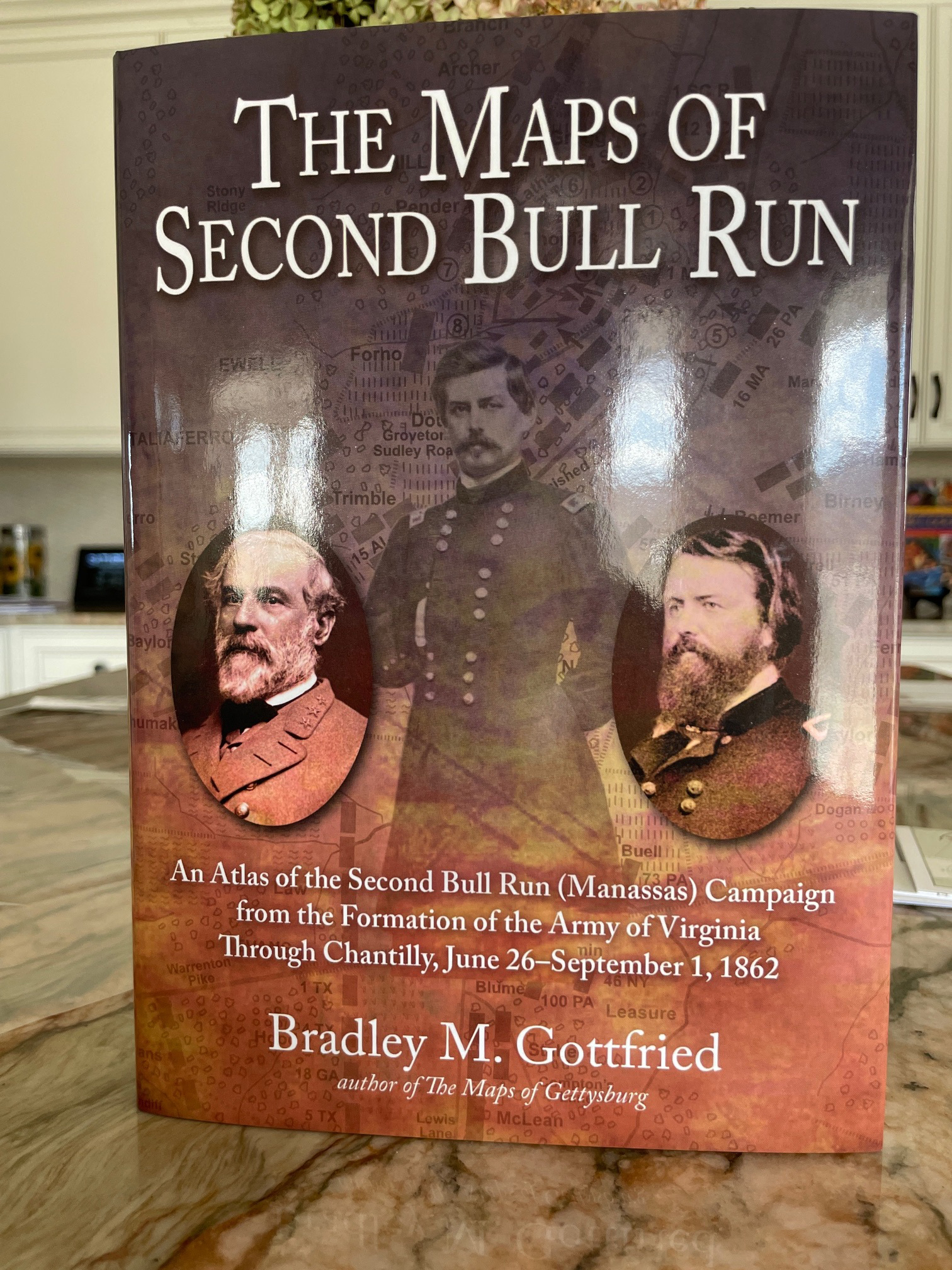
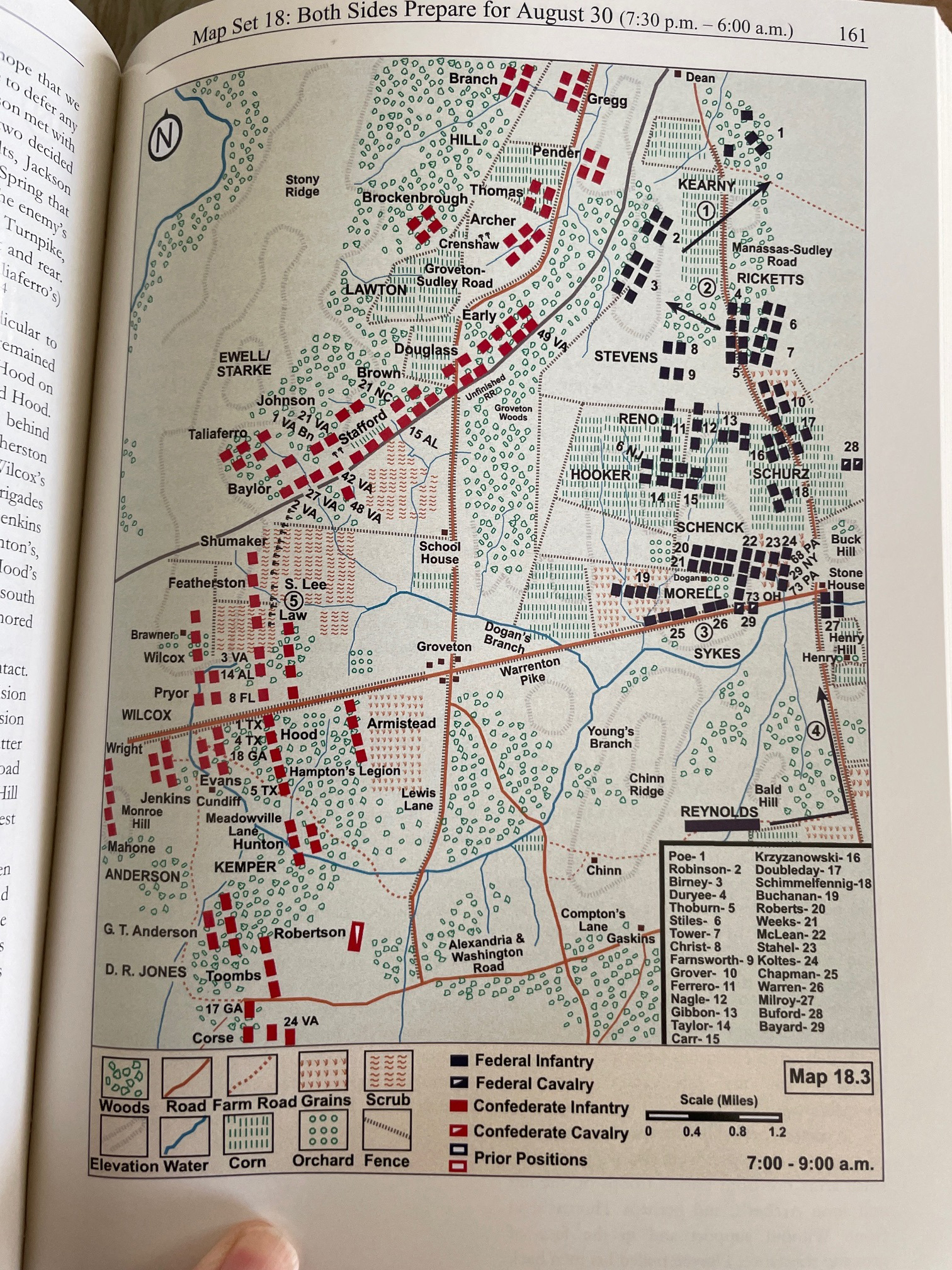
The book contains 122 full-color maps with a description on the facing page– as with all of my map books. It begins with the formation of the Army of Virginia and ends with Chantilly.
I have copies that I can sell for $35 (list is $40) plus $6 shipping. Let me know if you are interested.
This one was especially tough, as two distinguished authors, John Hennessey and Scott Patchan, both of whom I respect greatly, differed on a major portion of the battle. Unable to decide which author to follow, I asked Jim Burgess at Manassas National Military Park and he set me straight.
Here is an example of one of the maps:
Here is the publicity blurb:
The Maps of Second Bull Run: An Atlas of the Second Bull Run (Manassas) Campaign from the Formation of the Army of Virginia Through Chantilly, June 26–September 1, 1862 continues Bradley M. Gottfried’s efforts to study and illustrate the major campaigns of the Civil War. This is the tenth book in the ongoing Savas Beatie Military Atlas Series.
President Abraham Lincoln’s frustration with George B. McClellan’s inability to defeat Robert E. Lee and capture Richmond dramatically increased after the unsuccessful Seven Days’ Battles. In response, Lincoln combined three small armies into the new Army of Virginia and placed it under Maj. Gen. John Pope, who had overseen several successes in the Western Theater.
Pope’s aggressiveness and McClellan’s passivity on the Peninsula convinced Lee to send Thomas “Stonewall” Jackson’s wing of the Army of Northern Virginia to confront Pope. A bloody battle at Cedar Mountain on August 9 halted Pope’s move south, and Jackson’s raid on the vast stores at Manassas Junction triggered another confrontation, this time at Kettle Run.
When McClellan’s troops abandoned the Peninsula, Lee moved his other wing under James Longstreet rapidly north. Pope missed an opportunity to prevent the junction of Lee’s wings by not stopping Longstreet at Thoroughfare Gap.
The battle of Second Bull Run began on the evening of August 28 when Jackson tangled with Union troops at the Brawner Farm. Pope spent much of the next day hammering Jackson’s front, with no idea that Longstreet was arriving on the field. The Union assaults continued on August 30 until Longstreet launched a massive assault that rolled up the Union left flank and collapsed Pope’s army. The retreat was briefly interrupted by some of Jackson’s units at Chantilly, which ended the campaign.
The Maps of Second Bull Run plows new ground by breaking down the entire campaign into 24 map sets or “action sections,” enriched with 122 detailed full-page color maps. These cartographic originals bore down to the regimental and battery level. They include the march to and from the battlefields and virtually every significant event in between, including cavalry actions. At least two—and as many as ten—maps accompany each map set. Keyed to each piece of cartography is a full-facing page of detailed text describing the units, personalities, movements, and combat (including quotes from eyewitnesses) depicted on the accompanying map, all of which make the cavalry actions come alive.
This presentation allows readers to easily find a map and text on any portion of the sprawling campaign. Serious students will appreciate the extensive endnotes and complete orders of battle and take the book with them to the battlefields. A final bonus is that the maps unlock every other book or article written on any aspect of the campaign.
Perfect for the easy chair or for stomping the hallowed grounds, The Maps of Second Bull Run is a seminal work that belongs on the bookshelf of every serious and casual student of the battle.
 bradley gottfried
Hello Mr. Gottfried
What is next for you?
Don H.
Happy New Year, Don! Next up is the Maps of the Peninsula & Seven Days. I will take a small break after that to work on a Gettysburg project and then begin work on the Maps of the Shenandoah Valley or Chancellorsville.
The is a great addition to the series! I seem to recall hearing about a Maps of the Shiloh Campaign book by you and Sean Chick. Is that still in the works?
Yes, the first draft is finished, but the second is languishing. I am only doing the maps for this volume– another historian is actually writing the text and overseeing the project. He seems to be heavily tied up with other projects, so I am not optimistic this will ever see the light of day. When you hit 75-years old as I have, you know your days are numbered. Thanks for asking!
My vote (unrequested) is for Chancellorsville over Valley, if you have to choose one over the other.